Search is changing quickly.
People are no longer using Google only to type short keywords and open the first result. They are also asking longer questions, comparing options, researching products and services, and using AI-powered search experiences to find answers.
For small businesses, this creates a new opportunity to think about AI SEO.
AI SEO is not about replacing traditional SEO with artificial intelligence. It is about using AI to improve research, content planning, optimization, and decision-making while continuing to follow strong SEO fundamentals.
Google says its AI search features, including AI Overviews and AI Mode, rely on core Search systems, while existing SEO fundamentals remain important.
So, what is actually changing?
Let’s look at 7 powerful ways AI SEO is changing SEO for small businesses in 2026.
What Is AI SEO?
AI SEO means using artificial intelligence to support different parts of search engine optimization.
For example, AI can help with:
- Keyword research
- Search intent analysis
- Content ideas
- Topic research
- Content organization
- Competitor research
- Content optimization
- Finding content gaps
- SEO data analysis
- Creating content briefs
- Improving readability
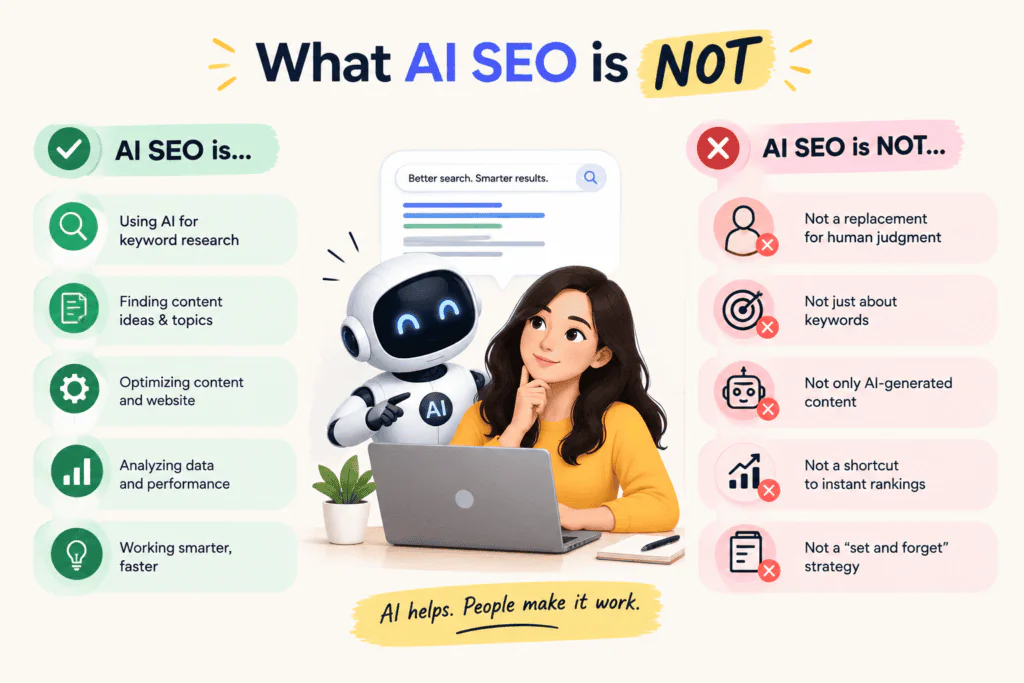
But AI should not replace human judgment.
For example, an AI tool might suggest 20 keywords for a website. That does not mean all 20 keywords are useful for the business.
A business owner still needs to ask:
Does this keyword match what my customers actually want?
That is where SEO knowledge, business understanding, and human experience become important.
7 Powerful Ways AI SEO Is Changing Small Business Search in 2026
1. Search Is Becoming More Conversational
Traditional search queries are often short.
For example:
digital marketing agency
But a customer might now ask:
What should a small business look for when choosing a digital marketing agency?
The second question provides much more context.
AI-powered search experiences are designed to help users explore complex questions and related information.
For small businesses, this means your content should not focus only on individual keywords.
Instead, think about the questions your customers actually ask.
For example, instead of creating a page that only targets:
digital marketing agency
you could create useful content answering questions such as:
- How does a digital marketing agency help a small business?
- What services should a small business start with?
- How much digital marketing does a small business need?
- How can a business measure marketing results?
- What should a business check before hiring a digital marketer?
The goal is not to create content for an algorithm.
The goal is to create content that answers the customer’s question clearly.
2. AI SEO Is Changing Keyword Research
Keyword research is still important, but the way businesses use keywords is becoming more flexible.
Search engines are increasingly able to understand the relationship between a page and different searches without requiring every exact keyword variation to appear on the page.
For example, if your main topic is AI SEO, related topics might include:
- AI for SEO
- AI SEO tools
- AI SEO optimization
- AI and SEO
- AI search optimization
- AI content optimization
- AI SEO strategy
- SEO automation
You do not need to repeat these phrases again and again.
Instead, use them where they genuinely help explain the topic.
A better approach is:
One main topic → related questions → useful answers → natural keyword usage
This creates content that is easier for both people and search systems to understand.
3. AI Can Make SEO Research Faster
One of the biggest benefits of AI SEO is speed.
Small businesses often have limited time and resources. Researching keywords, competitors, customer questions, and content ideas manually can take a lot of time.
AI can help organize this research.
For example, you could use AI to create a starting list of questions that customers may ask about local SEO.
The list could include:
- What is local SEO?
- How does Google Business Profile help?
- What local keywords should a business target?
- How can reviews affect local visibility?
- What pages should a local business have?
But AI-generated research should be treated as a starting point, not the final answer.
You should verify important information and add your own understanding before publishing.
This is especially important when writing content that represents your business.
4. Content Quality Matters More Than Simply Using AI
One of the biggest mistakes a business can make is thinking:
“If I use AI to create hundreds of articles, my website will automatically rank.”
That is not a reliable SEO strategy.
AI can help you research and organize information, but your content still needs to provide value.
For example, instead of writing:
A CTA is important because it encourages users to take action.
You could make the explanation more useful.
Weak CTA:
Submit
Clearer CTA:
Get Your Free Website Audit
The second example gives the visitor a clearer idea of what happens next.
This is the difference between simply generating content and actually improving the user’s experience.
Before publishing AI-assisted content, ask:
- Is the information accurate?
- Does it answer the reader’s question?
- Did I add anything useful?
- Are there real examples?
- Is the content specific to the audience?
- Does it sound like my business?
- Would a reader learn something from it?
AI can help you create a draft.
Your job is to make the draft useful.
5. AI Search Makes Helpful Content More Important
AI-powered search does not mean businesses should stop creating useful website content.
Helpful content remains important.
For small businesses, your website should continue to have:
- Helpful information
- Clear page structure
- Crawlable pages
- Internal links
- Useful headings
- Descriptive images
- Good page experience
- Relevant information
- Accurate structured data where appropriate
For example, instead of publishing a short article called:
Why SEO Is Important
you could create a more useful guide explaining:
- What SEO does
- Why small businesses use SEO
- How keyword research works
- Which website pages need optimization
- What businesses should measure
- Common SEO mistakes
- How content supports organic visibility
The objective should be to solve the reader’s problem.
Not simply to mention a keyword as many times as possible.
6. Small Businesses Should Focus on Specific Topics
Large websites may have thousands of pages.
A small business does not need to copy that approach.
Instead, build useful content around topics connected to your customers and services.
For example, a digital marketing website could create content around:
SEO
- SEO for small businesses
- On-page SEO
- Technical SEO
- Local SEO
- AI SEO
Websites
- Website optimization
- Landing page design
- Mobile-friendly websites
- Website conversion
- Website speed
Performance Marketing
- Google Ads
- Lead generation
- Conversion tracking
- Marketing ROI
- Campaign optimization
This helps create a clear content focus.
If you want to explore the services NEXORA provides, you can visit the NEXORA Services page.
7. You Don’t Need a Special “AI SEO Trick”
There is a lot of discussion online about special techniques for ranking in AI search.
Be careful with these claims.
You don’t need to completely rebuild your SEO strategy just because search is becoming more AI-powered.
Instead, focus on the fundamentals.
Make Your Website Easy to Understand
Your important pages should be accessible to search engines.
Build Internal Links
Connect relevant pages together so visitors and search engines can discover related content.
For example, if you are discussing website optimization, you can naturally connect readers to your website-related work.
You can see examples of NEXORA’s work on the Our Work page.
Create Useful Content
Answer real questions instead of writing only to insert keywords.
Use Clear Structure
Use descriptive headings, short paragraphs, lists, examples, and relevant images.
Provide Useful Supporting Media
Use relevant images and videos when they actually improve the page.
Keep Structured Data Accurate
If you use structured data, it should match the visible information on the page.
The fundamentals still matter.
How Small Businesses Can Build an AI SEO Strategy
You don’t need a complicated system.
Start with these seven steps.
Step 1: Understand Your Customer
Before doing keyword research, understand:
- Who are your customers?
- What problem are they trying to solve?
- What questions do they ask?
- What services are they looking for?
- What prevents them from taking action?
The better you understand the customer, the better your content topics can become.
Step 2: Find Relevant Topics
Use different sources to find topics:
- Google search suggestions
- Keyword research tools
- Customer questions
- Competitor research
- Forums and communities
- Existing website data
- Search Console data
AI can help you organize these ideas, but don’t blindly accept every suggestion.
Step 3: Understand Search Intent
Before writing an article, ask:
What does the person actually want to know?
A keyword may have different types of search intent.
Informational
The user wants information.
Example:
What is AI SEO?
Commercial
The user is researching options.
Example:
Best AI SEO tools for small business
Transactional
The user is closer to taking action.
Example:
AI SEO service for small business
Your content should match the intent behind the search.
Step 4: Create Useful Content
Answer the main question clearly.
Then cover important related questions without adding unnecessary information.
Don’t write 2,000 words when the user needs 500.
Don’t write 500 words when the topic genuinely requires a detailed explanation.
Write enough to solve the problem properly.
Step 5: Add Original Value
This is where small businesses can differentiate themselves.
Add:
- Your own observations
- Practical examples
- Screenshots
- Original analysis
- Processes
- Case studies
- Lessons from your work
- Industry-specific examples
AI can generate general information.
Your experience can make that information more useful.
Step 6: Optimize the Page
After writing, check:
- SEO title
- H1
- Meta description
- URL
- Headings
- Image ALT text
- Internal links
- External references
- Mobile experience
- Page speed
- CTA
SEO should improve the content rather than make it difficult to read.
Step 7: Track Results
After publishing, don’t immediately assume the article worked or failed.
Give the page time to collect data.
Then use tools such as Google Search Console and analytics to monitor:
- Impressions
- Clicks
- Search queries
- Average position
- Pages receiving traffic
- Organic traffic
- Conversions
The data can help you understand what people are actually searching for.
What AI Cannot Replace in SEO
AI is a powerful tool, but there are important parts of SEO that still require human understanding.
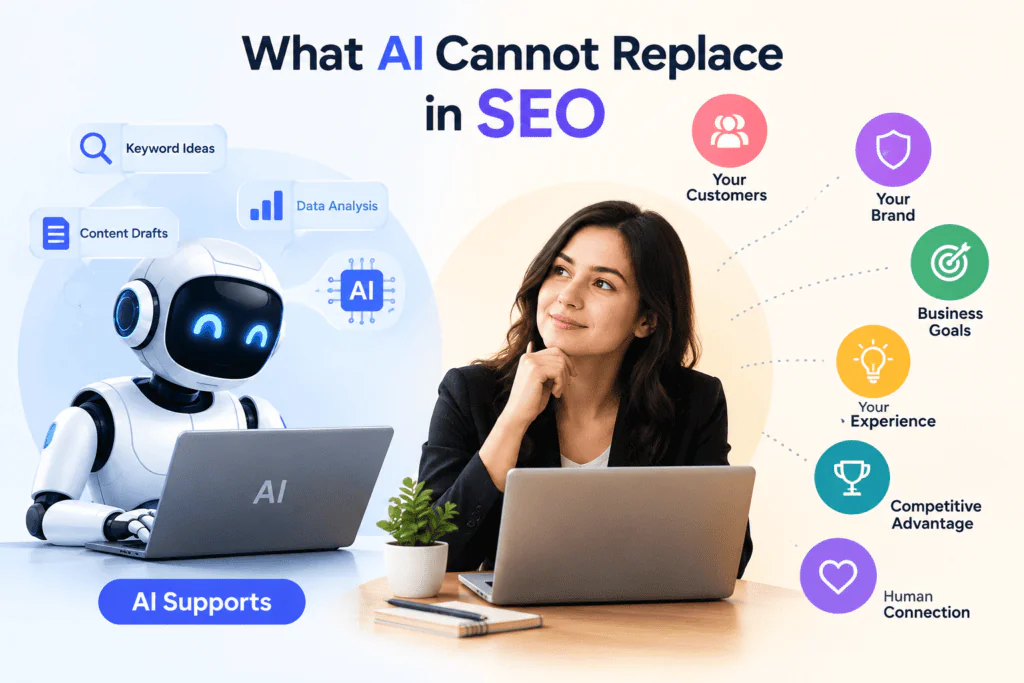
Your Customers
AI doesn’t automatically know your audience.
You understand:
- Their problems
- Their questions
- Their expectations
- Their buying concerns
- Their experiences
Customer understanding helps you create content that feels relevant.
Your Brand
AI can generate different writing styles.
But your brand needs a consistent identity.
Your website should communicate:
- What you do
- Who you help
- How you work
- What makes your approach different
AI can assist with writing.
You define the identity.
Your Business Goals
SEO should connect with a real business objective.
For example:
More traffic
is not always the final goal.
A business may actually want:
More qualified leads.
Another business may want:
More local customers.
Another may want:
More product sales.
Your SEO strategy should reflect the actual business goal.
Your Experience
AI can summarize information that already exists.
But your own experience can provide something different.
For example, you might discover that a particular CTA works better for a specific audience.
That observation can become useful content.
Real experience gives your content something that generic information cannot easily provide.
Your Competitive Advantage
AI can analyze competitors.
But your business still needs to decide:
What do we want customers to remember about us?
Your positioning, offer, process, customer experience, and ideas come from your business decisions.
Human Connection
Trust matters.
People don’t always choose a business because it has the most optimized webpage.
They may choose it because the business:
- Understands their problem
- Explains things clearly
- Feels trustworthy
- Shows real experience
- Provides useful information
AI can assist your SEO workflow.
It cannot replace the relationship between a business and its customers.
AI SEO Checklist for Small Businesses
Before publishing an AI SEO article, use this checklist.
Research
☐ Understand the target audience
☐ Understand search intent
☐ Research relevant keywords
☐ Check related questions
☐ Review competing content
Content
☐ Answer the main question
☐ Provide original value
☐ Use examples
☐ Verify important information
☐ Avoid unnecessary repetition
On-Page SEO
☐ Use the primary keyword naturally
☐ Add the keyword to the SEO title
☐ Add the keyword naturally in the introduction
☐ Use relevant headings
☐ Create a simple URL
☐ Write a useful meta description
☐ Optimize image ALT text
☐ Add relevant internal links
☐ Add trustworthy external references
User Experience
☐ Make the article easy to scan
☐ Use short paragraphs
☐ Make it mobile-friendly
☐ Use helpful images where appropriate
☐ Add a relevant CTA
Frequently Asked Questions About AI SEO
Is AI SEO replacing traditional SEO?
No. AI is changing how SEO work is performed and how people interact with search, but fundamental SEO practices remain important.
Can AI write SEO content?
AI can help with research, organization, and drafting.
However, businesses should review, verify, and improve AI-assisted content so that it provides genuine value instead of simply producing large amounts of generic content.
Is AI SEO useful for small businesses?
Yes. AI can help small businesses save time on tasks such as research, keyword organization, content planning, and optimization.
However, the business still needs to make the final decisions and provide useful, relevant information.
Do I need special AI SEO tools to appear in AI search?
You don’t need a special tool simply because search is becoming more AI-powered.
Focus first on strong SEO fundamentals, useful content, accessible pages, internal links, and a good user experience.
What should small businesses focus on first?
Start with the basics:
- Understand your audience.
- Research relevant topics.
- Create useful website pages.
- Make your website technically accessible.
- Build relevant internal links.
- Publish helpful content.
- Measure performance.
Final Thoughts
AI SEO is changing how businesses approach search in 2026, but the fundamental goal has not changed: help people find useful information.
Small businesses don’t need hundreds of AI-generated articles.
Instead, focus on a smaller number of useful topics that are closely connected to your customers, products, and services.
Use AI to:
- Research faster
- Organize ideas
- Find content gaps
- Analyze information
- Improve drafts
- Support your SEO workflow
But add your own:
- Experience
- Knowledge
- Examples
- Analysis
- Business understanding
The future of SEO is not simply about using more AI.
It’s about using AI intelligently while creating content that people actually find useful.
Explore NEXORA
Want to explore more about NEXORA’s work and digital growth approach?
Visit the NEXORA Services page to explore available services.
You can also view examples of work on the NEXORA Our Work page.
Learn more about the person and approach behind NEXORA on the About Us page.
For more digital marketing and SEO insights, visit the NEXORA Blog.
Have a project or website question? Contact NEXORA.