Introduction
Running a small business is not easy.
You need to find customers, build trust, increase sales, and manage daily work. At the same time, your customers are spending more time online.
They search on Google. They watch videos. They check Instagram pages. They read reviews before buying.
This is why digital marketing for small businesses is so important.
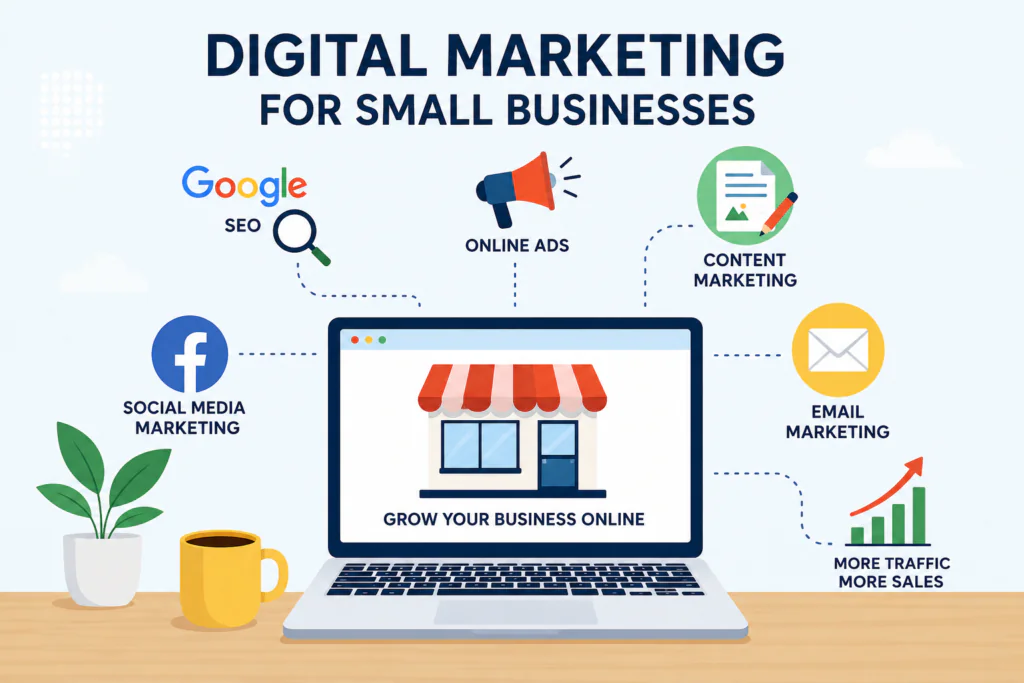
Digital marketing helps your business reach people online. It can help you bring more visitors to your website, get new leads, and build a strong online presence.
You do not need a huge budget to start. You also do not need to use every marketing channel at once. NEXORA Services page
You can start with simple steps. You can improve your website, use SEO, create useful content, build your social media presence, and use paid ads when needed.
In this guide, you will learn how digital marketing works and how a small business can use it to grow.
Digital marketing for small businesses can help a new business reach people without needing a large marketing team.
Table of Contents
What Is Digital Marketing for Small Businesses?
Digital marketing means promoting your business through online channels.
These channels can include Google, websites, social media, email, online ads, and other digital platforms.
For example, imagine you own a small salon.
A person in your city searches for:
“best salon near me.”
Your salon appears in the search results.
The person visits your website or Google Business Profile. They look at your services and reviews. Then they call you.
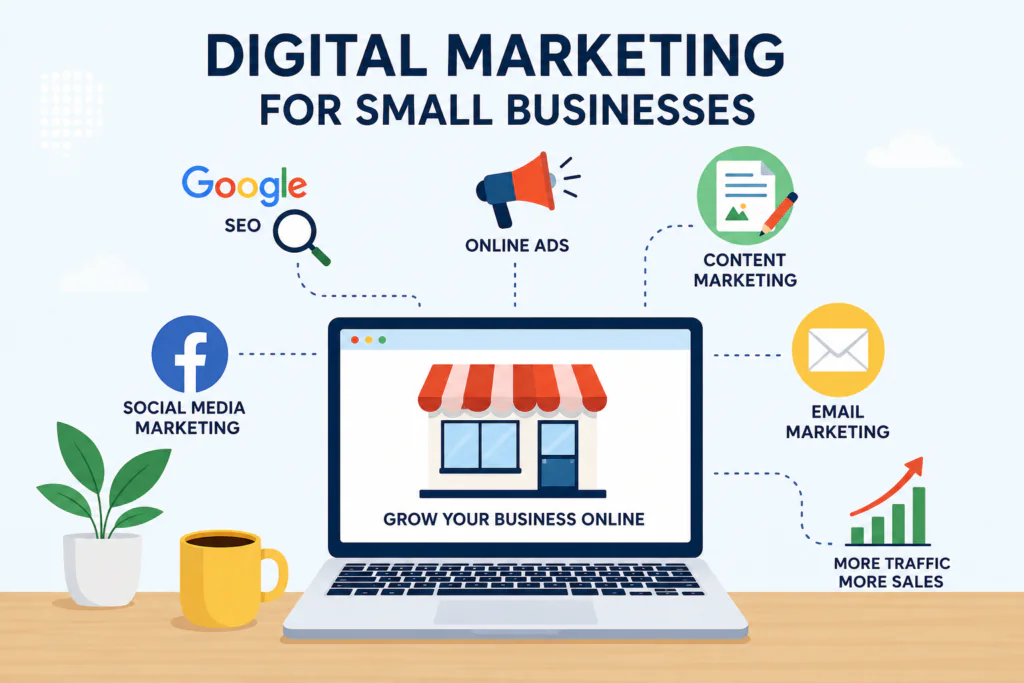
This is a simple example of digital marketing.
Small business digital marketing can include:
- Search engine optimization
- Social media marketing
- Content marketing
- Google Ads
- Meta Ads
- Email marketing
- Local SEO
- Website optimization
- Online reviews
The right strategy depends on your business, customers, budget, and goals.
Why Digital Marketing Is Important for Small Businesses
People now use the internet to find almost everything.
They search for restaurants, shops, services, products, professionals, and local businesses.
If your business is not visible online, you may miss many potential customers.
One major benefit of digital marketing for small businesses is that it can help you reach customers who are already searching for your products or services.
1. Customers Can Find You
A good online presence makes it easier for people to discover your business.
For example, a person may search:
“digital marketing agency for small business.”
If your website has useful content about this topic, it may appear in search results.
This can bring a new visitor to your website.
2. It Builds Trust
Customers want to know if a business is reliable.
They may check your:
- Website
- Reviews
- Social media
- Photos
- Services
- Customer feedback
A professional online presence can make your business look more trustworthy.
3. It Can Increase Website Traffic
SEO and useful content can help your website receive visitors from Google.
Unlike some forms of advertising, useful content can continue bringing visitors after it is published.
This makes SEO an important part of an online marketing strategy for small business.
4. You Can Reach the Right Audience
Digital marketing allows you to target specific groups.
For example, you can target people based on:
- Location
- Age
- Interests
- Search terms
- Online behavior
This can help you avoid wasting money on people who are not interested in your business.
Benefits of Digital Marketing for Small Businesses
Digital marketing can provide several benefits.
Digital marketing for small businesses can help you reach more people and bring more visitors to your website.
More Online Visibility
Your website and social media pages can help more people discover your business.
Better Customer Connection
Social media allows you to communicate directly with your audience.
More Leads
A good website can turn visitors into calls, messages, form submissions, or inquiries.
Better Brand Awareness
Regular content can help people remember your business.
Measurable Results
You can track website visitors, clicks, leads, calls, and ad results.
This makes it easier to understand what is working.
Best Digital Marketing Strategies for Small Businesses
There are many digital marketing methods.
However, you do not need to use all of them.
Start with the methods that match your business goals.
1. SEO for Small Businesses
SEO means Search Engine Optimization.
It helps your website appear in search engine results.
For example, suppose you own a furniture shop
SEO is an important part of digital marketing for small businesses because it can help your website appear in Google search results.
Your customers may search:
- furniture shop near me
- wooden furniture shop
- custom furniture
- office furniture
- sofa shop near me
You can create useful website pages and blog posts around relevant searches.
This is one reason SEO for small business can be powerful.
SEO is an important part of digital marketing for small businesses because it can help your website appear in Google search results.
Start With Keyword Research
First, understand what your customers search for.
Choose keywords that are:
- Relevant to your business
- Useful to your customers
- Specific enough to target
- Related to your products or services
Do not fill your page with the same keyword again and again.
Write for people first.
Create Useful Pages
Your website should have clear pages for important services.
For example:
- Home
- About
- Services
- Products
- Blog
- Contact
Each page should answer the questions your customers have.
Write Helpful Blog Posts
Blog content can bring people to your website.
For example, a fitness center could write:
“10 Simple Exercises for Beginners.”
Someone searching for beginner exercises may find the article.
That person can then discover the fitness center’s services.
2. Local SEO for Small Businesses
Local SEO is very useful for businesses that serve a particular location.
For local companies, digital marketing for small businesses can make it easier to connect with customers in nearby areas.
Examples include:
- Restaurants
- Salons
- Clinics
- Gyms
- Repair services
- Coaching centers
- Real estate businesses
- Local shops
Start by creating and updating your Google Business Profile.
Start by creating and updating your Google Business Profile. Make sure your business information is correct.
Make sure your information is correct.
Add:
- Business name
- Phone number
- Website
- Business category
- Working hours
- Services
- Photos
You should also encourage real customers to leave honest reviews.
Good reviews can help build trust with new customers.
Keep your business information consistent across important online platforms.
3. Social Media Marketing
Social media is another useful part of digital marketing for small businesses.
You can use platforms such as Instagram, Facebook, LinkedIn, or YouTube.
But do not post only advertisements.
People want useful and interesting content.
For local companies, digital marketing for small businesses can make it easier to connect with customers in nearby areas.
For example, a clothing store can share:
- Styling tips
- New arrivals
- Outfit ideas
- Customer photos
- Product information
- Fashion tips
A restaurant can share:
- Food photos
- Behind-the-scenes videos
- Customer reviews
- Special offers
- Cooking tips
The goal is to give people a reason to follow your business.
Social media is a useful part of digital marketing for small businesses because it helps you connect with potential customers.
Follow a Simple Content Mix
You can try this:
40% Educational Content
Teach something useful.
30% Trust Content
Share reviews, results, and customer stories.
20% Engagement Content
Ask questions and create simple polls.
10% Promotional Content
Talk about your products, services, or offers.
This can make your social media page feel more helpful and less like a constant advertisement.
4. Content Marketing
Content marketing means creating useful content for your audience.
This can include:
- Blog posts
- Videos
- Guides
- Case studies
- FAQs
- Social media posts
- Infographics
- Checklists
Good content can answer customer questions before they contact you.
For example, a website design company can publish:
“How Much Does a Business Website Cost?”
A business owner searching for this information may find the article.
The visitor may then explore the company’s website services.
This is how content marketing for small business can support both traffic and leads.
Another useful part of digital marketing for small businesses is paid advertising.
5. Google Ads for Small Businesses
SEO can take time.
Google Ads can help you reach potential customers faster.
For example, suppose you run an AC repair business.
Someone searches:
“AC repair near me.”
Your Google ad may appear when that person is looking for the service.
But running ads does not automatically guarantee sales.
You need a good strategy.
Before starting Google Ads, make sure you have:
- A clear offer
- Relevant keywords
- Good ad copy
- A useful landing page
- Conversion tracking
- A realistic budget
Do not only measure clicks.
Check how many people actually become leads or customers.
If you receive many clicks but no leads, something needs to change.
The problem may be the keyword, advertisement, landing page, offer, or customer journey.
6. Email Marketing
Email marketing can help you stay connected with existing customers.
For example, an online store can send emails about:
- New products
- Special offers
- Helpful tips
- Product updates
- Seasonal sales
Email is especially useful when you already have customer contacts who have given permission to receive your messages.
Do not send too many emails.
Make each email useful.
Common Digital Marketing Mistakes
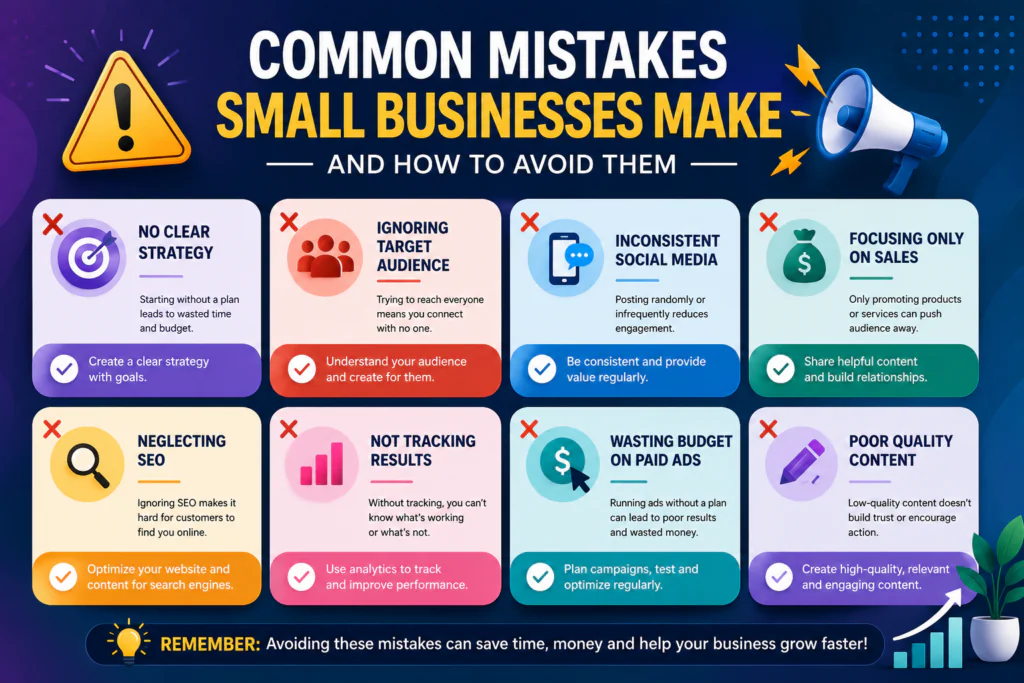
Small businesses often make simple mistakes.
Here are some important ones to avoid.
Mistake 1: Trying Everything at Once
You do not need to use every platform.
Start with the channels that your customers use.
Mistake 2: Only Posting Sales Content
If every post says “Buy Now,” people may lose interest.
Mix promotional content with useful content.
Mistake 3: Ignoring SEO
A beautiful website is not enough.
People need to find it.
Use basic SEO on your important pages and blog posts.
Mistake 4: Buying Fake Followers
Fake followers do not usually become real customers.
Focus on real people and useful engagement.
Mistake 5: Not Tracking Results
You need to know what is working.
Track:
- Website traffic
- Leads
- Calls
- Form submissions
- Ad clicks
- Sales
Use this information to improve your strategy.
A Simple Digital Marketing Strategy for Small Businesses
If you are a beginner, follow this simple plan.
Step 1: Understand Your Customer
Ask yourself:
Who is my ideal customer?
What problem do they have?
What do they search for online?
What makes them choose one business over another?
Your answers will help shape your marketing strategy.
Step 2: Build a Good Website
Your website should clearly explain what you offer.
Make sure visitors can quickly find:
- Your services
- Your products
- Your benefits
- Your contact details
- Your location, if relevant
- Customer reviews
Add clear buttons such as:
Contact Us
Get a Quote
Book a Consultation
Step 3: Start SEO
Find useful keywords.
Optimize your website pages.
Write helpful blog posts.
Make sure your website works well on mobile devices.
Step 4: Build Your Social Media Presence
Choose one or two platforms.
Post useful content regularly.
Do not worry about being perfect.
Focus on helping your audience.
Step 5: Collect Customer Reviews
Ask satisfied customers for honest feedback.
Reviews can help new customers feel more comfortable choosing your business.
Step 6: Consider Paid Ads
Once your website and offer are ready, you can test paid advertising.
Start with a controlled budget.
Track the results.
Step 7: Measure and Improve
Review your results every month.
Find out:
- Which pages get traffic?
- Which keywords bring visitors?
- Which posts get engagement?
- Which ads bring leads?
- Which pages convert visitors?
Then improve your strategy.
How Much Should a Small Business Spend on Digital Marketing?
There is no single budget that works for every business.
Your budget can depend on your industry, location, competition, goals, and current online presence.
A new business can start small.
For example, you could first focus on:
- Website improvements
- SEO
- Local SEO
- Organic social media
- Helpful blog content
Once you understand what works, you can add paid advertising.
The important thing is not simply spending more.
The goal is to spend wisely and measure the return.
When Should You Hire a Digital Marketing Agency?
You can do many basic marketing tasks yourself.
However, managing marketing can take a lot of time.
An agency may be useful when you need help with:
- SEO
- Google Ads
- Meta Ads
- Website optimization
- Content strategy
- Social media
- Performance tracking
- Lead generation
A good agency should not simply promise quick results.
It should explain the strategy.
It should track meaningful numbers.
It should also help you understand where your marketing budget is going.
At NEXORA, our goal is to help businesses build a stronger online presence with practical digital marketing strategies.
If you are unsure where to begin, you can contact NEXORA for a free consultation.
A Simple Example of Digital Marketing
Let’s take a simple example.
Imagine that Priya owns a small home bakery.
She wants more local customers.
First, she creates a simple website.
Then she creates a Google Business Profile.
She adds photos of her cakes and asks happy customers for honest reviews.
Next, she writes blog posts such as:
“How to Choose a Birthday Cake for 10 People.”
She also shares cake photos and short videos on Instagram.
After some time, people searching for cakes can discover her website and social media page.
She can then test Google Ads for important local searches.
This is a simple example of how different parts of digital marketing for small businesses can work together.
When used correctly, digital marketing for small businesses can support website traffic, leads, brand awareness, and long-term growth.
A good digital marketing for small businesses strategy can help improve website traffic, leads, and brand awareness.
FAQs
1. What is digital marketing for small businesses?
Digital marketing for small businesses means using online channels to promote a business and reach customers. It can include SEO, social media, websites, content, email, and paid advertising.
2. Which digital marketing strategy is best for a small business?
There is no single strategy for every business. SEO, local SEO, social media, content marketing, and paid ads can all help. The best choice depends on your customers and goals.
3. Is digital marketing expensive for small businesses?
It does not have to be expensive. You can start with low-cost methods such as SEO, local SEO, social media, and content. Paid ads can be added when your business is ready.
4. How can SEO help a small business?
SEO can help your website appear when people search for relevant products, services, or information. This can bring more organic traffic and create opportunities for leads.
5. Can I do digital marketing myself?
Yes. You can learn basic SEO, content marketing, and social media marketing yourself. However, an agency can help when you need advanced strategy, advertising, tracking, or more time to focus on your business.
Conclusion
Digital marketing for small businesses does not have to be difficult.
You do not need to use every marketing platform.
Start with the basics.
Build a useful website. Improve your SEO. Create helpful content. Use social media. Build customer trust. Track your results.
Most importantly, understand your customers.
Think about what they need.
Think about what they search for.
Then create content and marketing campaigns that help them.
Digital marketing is not a one-day activity.
It takes testing, learning, and regular improvement.
Start small. Measure your results. Keep improving.
If you want help creating a practical digital marketing strategy, NEXORA can help you plan your next step.
Ready to increase your online visibility and website traffic? Contact NEXORA today and request a free marketing strategy call.